
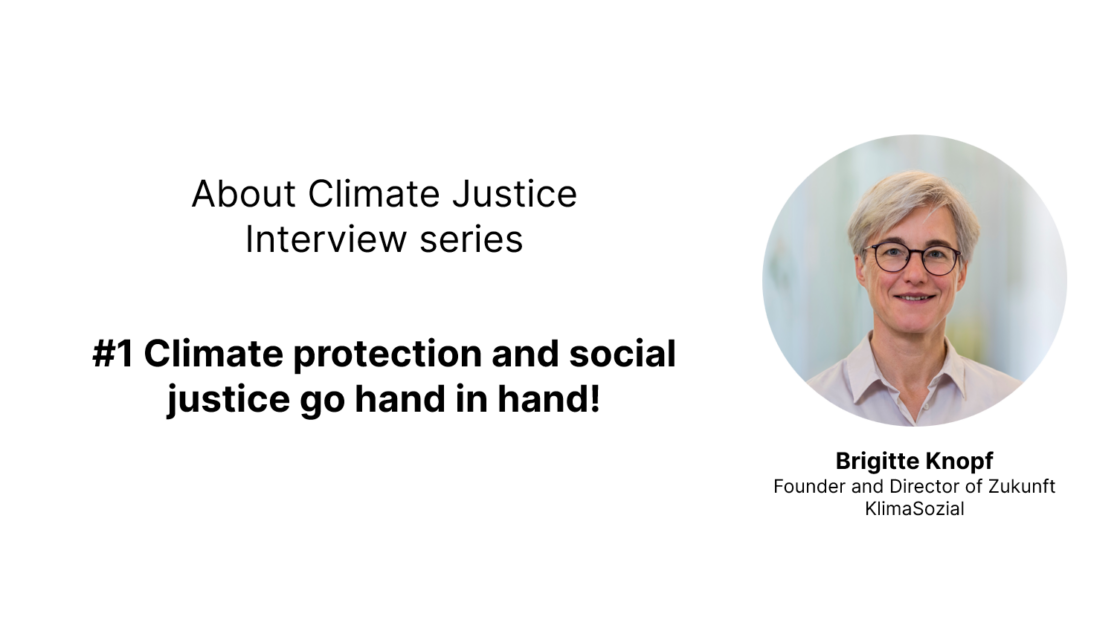
Brigitte Knopf, how are climate protection and social justice connected?
Climate protection and social justice are often discussed as opposing concepts, but for physicist and climate economist Brigitte Knopf, this is a fundamental misconception. In the first part of our CCPI interview series on climate justice, the founder of the think tank Zukunft KlimaSozial discusses why a successful climate policy must take social issues into account from the outset, which measures can particularly support low-income households during the transition, and what role Europe plays in shaping a just climate policy.
By founding the think tank ‘Zukunft KlimaSozial’, you have helped to raise awareness of the issues of distribution and fairness associated with climate policy. How did the institute come about, and what are the core principles behind it?
At the international level, the issues of fairness associated with climate policy are already the subject of much debate. With the launch of Zukunft KlimaSozial (Institute for Social Climate Policy), we are focusing primarily on low- and middle-income households in Germany and developing ideas and concepts on how they can benefit from the transition to climate neutrality. There are already many climate policy think tanks doing excellent work, but only a few take the social dimension explicitly into account. We want to change this by strengthening social policy and contributing to the development of social just climate protection measures from the outset, on an equal footing.
What is the link between climate action and social policy, and why is the latter so crucial to effective climate policy?
The transition towards climate neutrality in our lives and economic activities has entered a new phase. While climate policy in Germany previously focused primarily on the energy sector and industry, all sectors must now contribute to reducing greenhouse gas emissions to zero by 2045. The renovation of buildings and the transition in transport will directly affect the everyday lives of private households, particularly with regard to housing and mobility. In political debate, effective climate policy and social justice are often seen as incompatible. However, this way of thinking is misguided, as climate mitigation and social justice go hand in hand. When considered together, they can ensure better health, increased well-being, and more participation for everyone. Therefore, an integrated climate and social policy can benefit everyone, particularly vulnerable groups.
What are some examples of climate action that takes social justice seriously and is consequently accepted by large part of society? And which laws are examples of a lack of social balance in climate policy?
Fundamentally, social climate protection requires a comprehensive approach that encompasses both enabling measures and relief measures. To this end, we have developed a four-pillar model: to enable the transition, we need 1) infrastructure development, 2) socially tiered support programs, and 3) regulation to address issues such as the landlord-tenant split incentive. The fourth pillar is the option of direct income support as a compensatory measure, for example if carbon prices rise too sharply.
There are many good examples across Europe of climate action and social justice being considered and implemented together. These include social leasing for electric cars in France and a combination of grants and low-interest loans for vulnerable groups to renovate buildings in Scotland. The debate on this issue has only recently gained momentum in Germany, where there are also some positive examples. For instance, Germany has introduced socially tiered subsidy schemes for building renovation and electric cars. However, due to the high-income thresholds and the lack of support for used cars, there is a risk here that it is primarily middle- to high-income earners who benefit from the subsidies, rather than low-income households. Other good examples include the nationwide public transport ticket (Deutschlandticket[1]) combined with social tariffs, and the Electricity Saving Check (Stromsparcheck[2]), which helps lower-income households save energy. In the terms of regulation, the CO₂ Cost Sharing Act is worth mentioning, as it allocates CO₂ costs between landlords and tenants.
The problem is that there is still no way to provide direct income support based on financial need. This would be particularly important during the current energy crisis, as it would allow us to provide targeted relief to lower-income households.
Overall, it remains challenging for most support schemes to reach lower-income households. This could be improved by reducing administrative barriers and increasing efforts to inform these households about the schemes.
The second European Union Emissions Trading System (EU ETS2), which is set to cover the building heating and transport sectors from 2028 onward, is currently the subject of heated debate. The aim is to make the switch to climate-friendly propulsion technologies and heating systems more attractive by increasing the prices of fossil fuels at the petrol station and for heating with oil and gas. A key concern for many Member States is that citizens on middle and low incomes could suffer unduly from the price increases resulting from emissions trading. How can a socially acceptable framework be achieved that does not undermine the envisaged mitigation impact?
The European Social Climate Fund (SCF) was established this year[3] to support people through the transition to the new ETS2 emissions trading scheme for buildings and road transport, which is due to be introduced in 2028. The measures funded by the SCF are intended to benefit vulnerable households, micro-enterprises, and transport users who will be particularly affected by ETS2. The focus will be on transformative measures that enable people to make this transition, thereby reducing CO₂ emissions in the long term. To this end, Member States were supposed to submit a Social Climate Plan (SCP) by the end of June 2025, setting out how vulnerable groups will be supported. However, only eight countries have done so far. Germany’s plan is still missing.
What role does the EU Social Climate Fund play – through which a (capped) portion of the revenue is returned to the Member States – and how should it be structured to ensure that it adequately mitigates the social hardships caused by the emissions trading system?
The main purpose of the Social Climate Fund is to balance the burden across Europe, as countries with lower wages and higher energy poverty are disproportionately impacted by the uniform ETS2 price. These countries therefore receive a higher share of SCF funds, while wealthier countries such as Germany receive a smaller share. Although the SCF funds are insufficient for Germany given the scale of the problem, submitting a Social Climate Plan (SCP) is particularly important: this defines what is meant by energy or mobility poverty and how to specifically address vulnerable groups. From a financial perspective, however, the remaining revenue from the ETS2, which flows into the Climate and Transformation Fund (Klima- und Transformationsfonds KTF), is more relevant for Germany. Our analysis shows that only around 15% of the funds are earmarked for social purposes, which is insufficient.
What is your view on the calls from countries in the Global South for the largest (historical) emitters to contribute more towards the costs of mitigation and adaptation in regions of the world that are particularly affected or structurally weaker?
At an international level, climate justice plays a crucial role. Richer countries produce more climate-damaging emissions than poorer ones, and it is the latter that suffer the most severe consequences. Based on the ‘polluter pays’ principle, the costs of the climate crisis should be distributed fairly. Industrialised nations have a duty to provide financial support to developing countries for decarbonisation and climate adaptation. At the same time, the socio-economic consequences of climate change and the energy transition must be mitigated for the most vulnerable societies.
[1] The Deutschlandticket is a season ticket valid throughout Germany for local public transport. It is valid for an unlimited number of journeys on buses, trams, underground trains, suburban trains and regional trains. It costs €63 per month.
[2] The Stromsparcheck is a free energy and water advisory service for low-income households.
[3] The SCF was established this year, however, a payment is only possible from next year onward.

Dr Brigitte Knopf holds a PhD in physics and is one of the most prominent voices at the intersection of climate, energy and social policy in Germany. She is the founder and director of the think tank Zukunft KlimaSozial and former Secretary-General of the Mercator Research Institute on Global Commons and Climate Change (MCC). From 2020 to 2025, she served as Deputy Chair of the Expert Council on Climate Issues appointed by the German Federal Government. Her work focuses in particular on research and consultancy regarding climate economics and energy policy, as well as the socially just shaping of the transition to a climate-neutral society.
The interview was led by Jan Burck, Policy Advisor in Climate Protection & Energy and Project Manager of the Climate Change Performance Index at Germanwatch. It marks the start of a series of interviews by the CCPI team on the topic of climate justice.