 Belarus
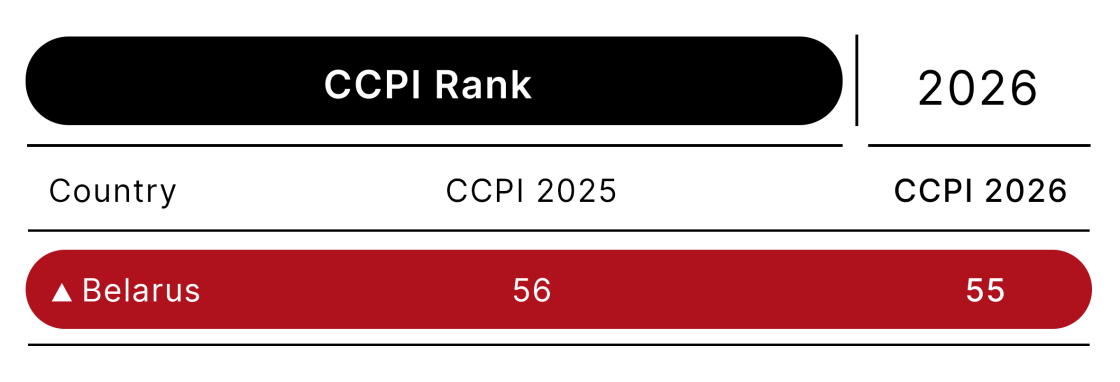
Belarus ranks 55th in the CCPI – up one spot from last year but still an overall very low overall performer. The country receives a low rating in GHG Emissions, very low in Renewable Energy and Climate Policy, and medium in Energy Use.
Belarus has yet to submit its third Nationally Determined Contribution (NDC). The country has no declared target for climate neutrality by 2050 and no specific activities planned to systematically reduce greenhouse gas (GHG) emissions.
Financially strapped with no funding to put toward climate action, as renewables are stalled or even falling back
Belarus also has no climate funds, and the Ministry of Natural Resources and Environmental Protection is not expected to be allowed to establish any. With severe budget deficits, available financial resources are directed toward covering fiscal gaps or strengthening the security apparatus, leaving no funding for climate action. The CCPI country experts are critical of the carbon market in place for being weak and insufficiently transparent for NGOs to participate in policymaking processes.
The majority of the country’s biomass projects were launched in the 2010s, often with international donor or development bank support. Since 2020, the expansion has slowed, with no major new biomass or biogas plants added. Existing plants continue operating. The government has shifted its focus to nuclear plants, while the renewable energy capacity has been frozen since 2020. Renewable energy development has stagnated and even existing installations face restrictions or shutdowns. The experts cite cases such as the Rechitsa solar plant as examples of the unstable and unfavourable investment conditions. Apparent improvements in indicators owe to demographic shifts rather than actual renewables expansion.
Belarus withdrew from many international fora, such as the Bern Convention (2023), in recent years, indicating the country is no longer bound to international obligations to protect rare species and habitats. This increases threats to biodiversity from biomass harvesting. The experts are concerned that bioenergy development may proceed without environmental and social safeguards, raising the risk of greenwashing rather than true protection of nature.
Environmental information vacuum with NGOs silenced
Environmental NGOs that previously monitored and sounded the alarm about illegal logging and road destruction in protected areas have had to stop their work. The loss of independent oversight has created an information vacuum regarding the true scale of forest degradation and wetland drainage. Belarus is the world leader in peat briquette production, with around two million tons of peat mined annually. No effective regulatory measures are in place to limit peat cutting. The experts are also troubled by the effect of the lack of independently working NGOs on the development of sustainable agricultural practices, because these had played a crucial role in training farmers and sharing European best practices.
The experts note that emissions could increase slightly without substantial new investment, institutional reform, and the creation of a functioning carbon management system. They call on the Belarus authorities to set clear emissions targets and allow the participation of NGOs and subnational actors in the processes. They also recommend focusing on renewable energy source development.
Key Outcomes
- Belarus ranks 55th in the CCPI – up one spot from last year but still an overall very low overall performer
- With severe budget deficits, available financial resources are directed toward covering fiscal gaps or strengthening the security apparatus, leaving no funding for climate action
- Key demands: set clear emissions targets and allow the participation of NGOs and subnational actors in the processes
CCPI experts
The following national experts agreed to be mentioned as contributors for this year’s CCPI:
- Iryna Ponedelnik
- Ivan Filiutsich