 United Arab Emirates
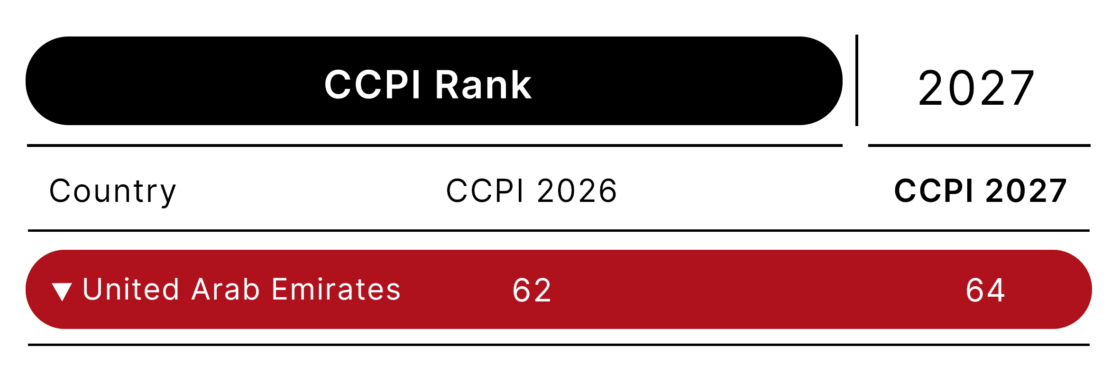
The United Arab Emirates (UAE) ranks 64th in the CCPI, down two places from the previous year. It is a very low performer, receiving a low rating in Renewable Energy and Climate Policy, and very low in GHG Emissions and Energy Use. In Energy Use, it ranks lowest of all countries assessed.
Fossil fuel expansion weakens climate policy framework
The UAE submitted its first Long-Term Low Emissions Development Strategy to the United Nations Framework Convention on Climate Change (UNFCCC) in 2024 and operationalised its federal Climate Law. However, the CCPI country experts note that ongoing expansion of fossil fuel extraction and export infrastructure weakens the UAE’s policy framework and runs counter to long-term decarbonisation goals. The lack of a binding carbon price, clear interim emissions caps, and a concrete plan to phase out fossil fuels means its overall ambition falls short of a 1.5°C pathway.
Renewables grow but UAE remains major gas and oil producer
The UAE continues to invest heavily in renewable energy and nuclear power, with a focus on energy security. The experts note that the UAE’s renewable energy auctions and independent power producer (IPP) framework have consistently delivered some of the world’s lowest-cost solar energy projects. This success, they indicate, is backed by substantial public investment from entities such as Masdar and Dubai Electricity and Water Authority (DEWA), as well as clear long-term targets, making it the most effective driver of decarbonisation in the country. However, the experts also emphasise that the UAE remains committed to expanding hydrocarbon production and safeguarding the long-term role of oil and gas in the global energy system.
The UAE is among the 10 countries with the largest developed oil reserves and it currently plans to increase its gas and oil production. Climate policy in the country continues to rely heavily on technological solutions, such as carbon capture and hydrogen, rather than on a clearly defined and time-bound transition away from fossil fuels. The experts therefore recommend publishing a national fossil fuel phase-out roadmap with clear timelines, including subsidy reform and limits on new extraction projects. They also recommend setting enforceable interim emissions caps with transparent monitoring and ensuring alignment of sectoral policies with the 2050 net-zero target. Investments in grid modernisation and storage are also needed for integrating higher shares of variable renewables and strengthening system flexibility.
Efficiency and electrification need stronger policies
Regarding energy use and electrification, the experts criticise the absence of federal carbon pricing or binding efficiency caps, persistent car dependence, limited freight decarbonisation, and uneven, insufficient retrofits across an energy-intensive existing building stock. They recommend that the UAE accelerate large-scale energy efficiency and retrofit programmes in buildings, industry, and transport, reduce reliance on unproven future technologies, and mandate best available technology standards for industry, paired with fiscal incentives and green procurement.
Climate diplomacy expands but fossil fuel expansion limits international credibility
The UAE is expanding its international climate diplomacy profile after hosting the 28th UN Climate Change Conference (COP28) and brokering the UAE Consensus, which explicitly references a transition away from fossil fuels. The country is active in several international climate initiatives and is mobilising climate finance. However, the experts warn that continued expansion of oil and gas production and liquefied natural gas (LNG) export capacity directly contradicts this. They recommend that the UAE join binding international initiatives that commit to phasing out fossil fuels and increase its contributions to climate finance toward fair-share levels, with a stronger balance between adaptation and mitigation and more grant-based disbursement.
Overall, the experts recommend that the UAE adopt a legally binding and time-bound cap on fossil fuel extraction. A strengthened, 1.5°C-aligned emissions budget for 2030 and an economy-wide carbon price should back this cap to guarantee delivery.
Key outcomes
- The UAE ranks 64th in the CCPI, down two places from the previous year, and is a very low performer.
- With a focus on energy security, the UAE is expanding its renewable energy capacity while also developing its fossil fuel resources.
- Key demands: Adopt a fossil fuel phase-out plan, align the emissions budget with 1.5°C, and introduce an economy-wide carbon price
CCPI Experts
National experts that contributed to the policy evaluation of this year’s CCPI chose to remain anonymous.