 United Arab Emirates
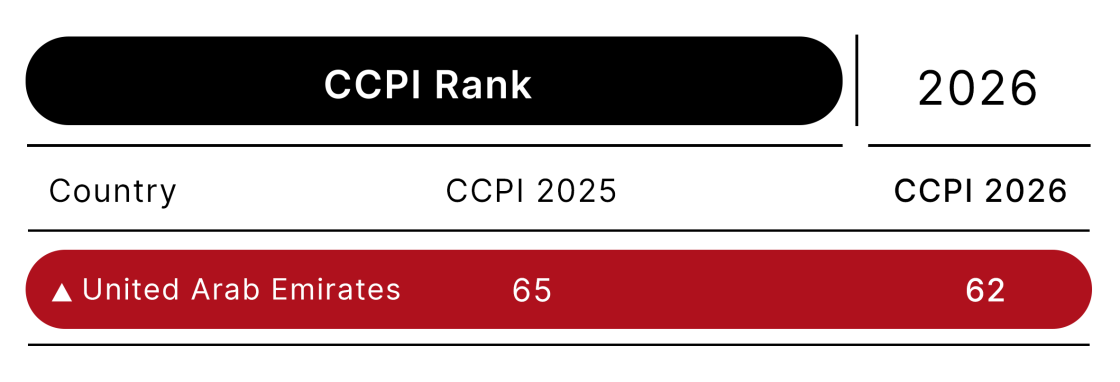
The United Arab Emirates remains a very low performer, ranked 62nd in the CCPI. The UAE receives a medium rating in Climate Policy, low in Renewable Energy, and very low in GHG Emissions and Energy Use. In the latter, it is ranked lowest of all surveyed countries.
Last year, the UAE adopted Federal Decree-Law No. (11) of 2024 on the Reduction of Climate Change Effects, which includes a commitment to achieving net zero by 2050. The CCPI country experts welcome this ambitious target, but they note the absence of concrete implementation measures such as incentives, a binding carbon price, clear emissions caps, and a fossil fuel phase-out plan. The country, thus, remains off track for aligning with a 1.5°C pathway. The UAE has expanded solar photovoltaic generation through strong government-led projects and independent power producer auctions. However, natural gas still dominates the electricity mix, accompanied by ongoing fossil fuel expansion.
A large investor in climate funds, but continuing steadfast support for fossil fuels
While the experts did not report systemic human rights abuses within renewable energy projects, there are concerns about migrant labour risks (such as recruitment fees, inadequate housing, and excessive working hours) in large-scale construction projects, which may also extend to solar contractors.
At the international level, the UAE has pledged significant investments in climate-related funds, including the Loss and Damage Fund and ALTERRA platform, and has committed USD 4.5 billion to renewable energy projects in Africa. However, the experts criticise the country’s continued support for oil and gas and its refusal to join initiatives such as the Beyond Oil & Gas Alliance (BOGA). UAE: The country is among the 10 countries with the largest developed oil reserves, and it currently plans to increase its oil and gas production.
Overall, the experts call for a clear and binding fossil fuel phase-out strategy, an economy-wide carbon price, measurable emissions reduction targets, and stronger support for the domestic climate tech industry to ensure genuine progress toward the net-zero goals.
Key Outcomes
- The UAE remains a very low performer, ranked 62nd in the CCPI
- At the international level, the UAE has pledged significant investments in climate-related funds
- Key demands: a clear and binding fossil fuel phase-out strategy, an economy-wide carbon price, measurable emissions reduction targets, and stronger support for the domestic climate tech industry
CCPI experts
National experts that contributed to the policy evaluation of this year’s CCPI chose to remain anonymous.