 Bulgaria
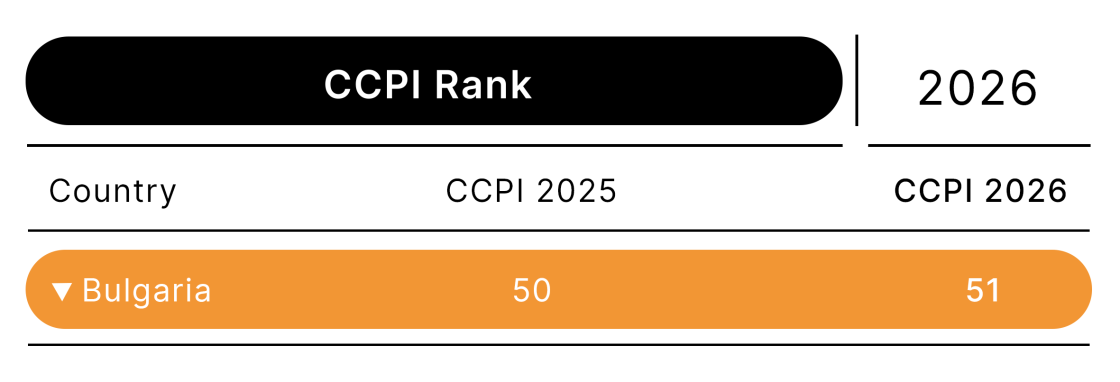
Bulgaria ranks 51st in the CCPI, remaining a low-performing country, as it was last year. The country receives a medium rating in GHG Emissions, a low in Renewable Energy and Energy Use, and a very low in Climate Policy.
Updated NECP has net-zero target but country’s international climate action has weakened
Bulgaria submitted its updated National Energy and Climate Plan (NECP) in January 2025, thereby introducing a climate neutrality target. The target was recently adopted in the Climate Change Mitigation Act. The CCPI country experts point out that the country’s Long Term Strategy (LTS) is outdated and no update process has officially started. Two categories of the NECP targets – land use, land use change, and forestry (LULUCF) and final energy consumption – fall below EU minimums.
Overall, the experts report that Bulgaria’s international climate stance has weakened, with unclear positions on the EU 2040 target and risks of joining blocking states.
Renewables have expanded rapidly in Bulgaria, with over 1,300 MW of solar capacity added in 2023, mostly by private initiatives. The experts criticise the lack of supportive policies, with bureaucratic hurdles, lack of incentives, and missing legislation for offshore wind and net metering. They also point out that grid integration remains insufficient and conflicts over land use are common due to poorly planned projects on farmland and protected areas.
Fossil exploration is planned and no phase-out plan exists, while energy poverty leads to coal and wet firewood use
Fossil fuel dependence remains high in Bulgaria. Coal subsidies continue and new oil and gas exploration is planned, with no fossil fuel phase-out strategy. The experts mention that the subsidies for fossil fuels per GDP exceed the EU average. There is substantial biomass use, especially for heating, but the experts raise concerns about fraud in reporting and sustainability. Many households are forced to rely on wet firewood and coal because of energy poverty.
Overall energy efficiency in the country remains weak. Industrial programmes exist, but support for individual households is limited and inconsistent. Renovation schemes rely completely on state grants and large-scale renovation is rare.
The experts favourably mention the growing attention given to sustainable agricultural practices, yet monocultures still receive large subsidies. The NECP lacks targets and measures for afforestation and land use.
The experts recommend stronger engagement in EU and UNFCCC processes. They advise updating the LTS in line with the EU goals. They recommend phasing out fossil fuel subsidies, halting new exploration projects, and developing a coal exit strategy. Additionally, they call for renovation programmes for energy-poor households and single-family buildings. Finally, they would like to see clear afforestation and land-use targets to strengthen carbon sinks.
Key Outcomes
- Bulgaria ranks 51st in the CCPI, remaining a low-performing country
- The country submitted its updated NECP in January 2025, thereby introducing a climate neutrality target
- Key demands: phasing out fossil fuel subsidies, halting new exploration projects, and developing a coal exit strategy
CCPI experts
The following national experts agreed to be mentioned as contributors for this year’s CCPI:
Radostina Slavkova (Za Zemiata – Friends of the Earth Bulgaria