 Bosnia and Herzegovina
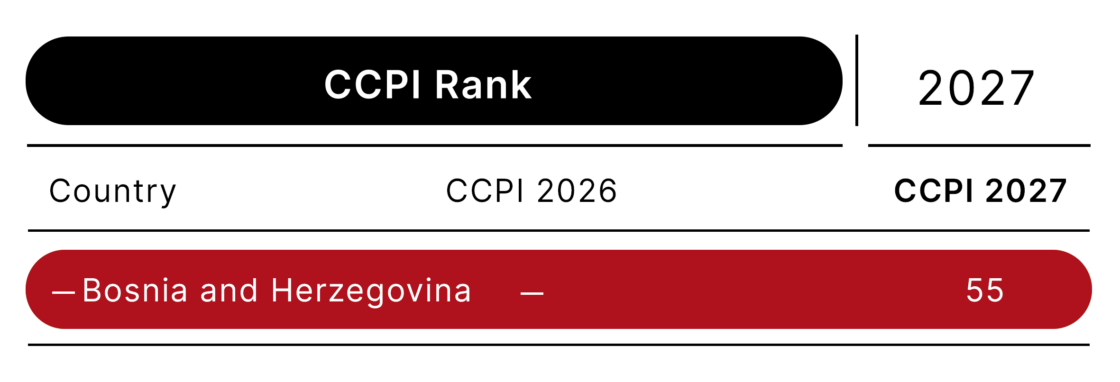
 makes its CCPI debut in 55th place, with an overall very low rating. The country receives a very low rating in GHG Emissions and low in Renewable Energy, Energy Use, and Climate Policy.
Climate commitments face implementation gaps
The CCPI country experts note a persistent gap between Bosnia and Herzegovina’s climate commitments and implementation. Preparations for a new Nationally Determined Contribution (NDC) show progress, though the country had not yet submitted it at the time of assessment. The current NDC targets a 33.2% reduction in greenhouse gas (GHG) emissions by 2030 compared with 1990, or 36.8% with international support. Despite the political commitment to climate neutrality by 2050, the country still lacks a formally adopted national net zero target.
In August 2026, Bosnia and Herzegovina submitted its first Biennial Transparency Report to the United Nations Framework Convention on Climate Change (UNFCCC), marking progress in climate transparency and international reporting. However, delays in adopting the final National Energy and Climate Plan (NECP), fragmented responsibilities, and weak implementation remain key shortcomings.
Heavy coal dependence persists despite growing solar deployment
The experts identify continued coal dependence, public support for the coal sector, and the absence of a legally binding phase-out timetable as major weaknesses. Solar deployment is growing. In the power sector, for example, solar accounted for around 8% of total electricity generation in 2025. Hydropower remained the dominant source of renewable electricity, supplying 37% of the country’s total electricity generation. Some of the experts raise environmental and social concerns about hydropower development, especially small projects, including impacts on rivers and inadequate community participation. New renewable energy legislation also provides a framework for prosumers and renewable energy communities. However, uneven implementation and insufficient grid capacity, storage, and flexibility continue to constrain the transition. Some of the experts also note progress toward a just transition in coal regions, including mine rehabilitation and support for affected workers and communities. These efforts remain limited to certain regions and do not yet constitute a comprehensive national coal phase-out pathway.
Public building renovation advances but transport and industry lack clear decarbonisation strategies
The experts identify public building renovation as one of the clearest areas of practical progress in energy efficiency. In 2024, the Federation of Bosnia and Herzegovina adopted a Long-Term Building Renovation Strategy to 2050. However, the experts consider the pace of renovation across the existing building stock insufficient. Authorities also do not consistently enforce building energy performance requirements. Transport policy remains fragmented, with a strong focus on road infrastructure and insufficient emphasis on public transport and rail. Charging infrastructure and financial incentives for electric mobility also remain limited. Industry lacks a comprehensive decarbonisation roadmap. Existing measures focus primarily on energy efficiency, while support for industrial electrification and replacing fossil fuels remains insufficient.
International climate engagement remains largely reactive
Bosnia and Herzegovina participates in the UNFCCC process, but the experts describe the country’s wider international climate engagement as largely reactive. They note limited leadership on fossil fuel phase-out and stronger climate ambition, alongside little proactive engagement in informal climate diplomacy.
The country participates in international initiatives such as the Global Methane Pledge and Climate and Clean Air Coalition. However, these commitments have not consistently translated into domestic action. A national methane roadmap remains under development. The EU accession process offers opportunities to strengthen climate policy. However, the experts caution that adopting EU rules alone will not deliver decarbonisation without effective implementation. The country has made some progress in mobilising climate finance for adaptation and low-carbon public buildings. Nevertheless, the experts note continued dependence on external support and consider the scale of finance mobilised limited relative to the country’s investment needs.
The experts call for NECP adoption and implementation, a binding coal phase-out timetable, and a properly financed just transition. Priorities include faster renewable energy deployment, energy efficiency, and grid investment. Some of the experts also advocate carbon pricing and fossil fuel subsidy reform, with protection for vulnerable households. Further recommendations emphasise stronger institutions and local participation, while also taking security of supply, resilience, and economic development into account.
Key outcomes
- Bosnia and Herzegovina makes its CCPI debut in 55th place, with a very low overall rating.
- Coal dependence persists despite early progress in solar deployment and advances in public building renovation.
- Key demands: Submit NDC 3.0, adopt and implement the NECP, set a binding coal phase-out timetable, accelerate renewable energy deployment and grid modernisation, and properly finance a just transition
CCPI experts
The following national experts agreed to be mentioned as contributors for this year’s CCPI:
- Mirza Kušljugić (University of Tuzla and RESET Center for Sustainable Energy Transition Sarajevo)
- Harisa Karakaš (ENOVA)
- Ajla Sijarić (Center for Energy, Environment and Resources – CENER 21)