 Colombia
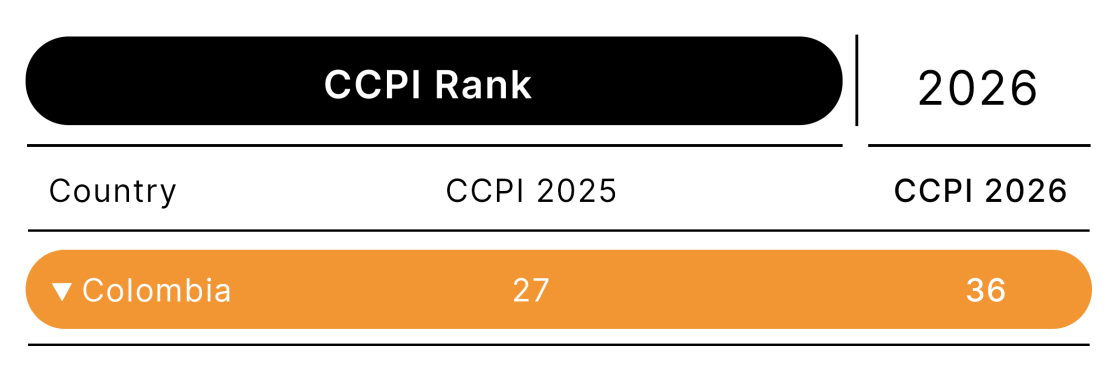
Colombia ranks 36th overall and is a low performer in the CCPI. The country receives a high rating in Energy Use, medium in Climate Policy, and low in GHG Emissions and Renewable Energy.
Colombia submitted its Nationally Determined Contribution (NDC) 2.0 in 2020, committing to a 51% emissions reduction by 2030. The newest NDC 3.0 is still being developed and has yet to be submitted. The CCPI country experts call for more ambition in this updated NDC, with clear targets and financial transparency to ensure a just transition in Colombia.
Continued dependence on fossil fuels and no phase-out roadmap, as renewables projects affect communities
A high dependence on fossil fuels persists in Colombia, with no clear roadmap for phasing out coal, gas, and oil. Given that this is combined with weak financing and non-binding targets, the experts emphasise that the country must accelerate the expansion of renewable energy, eliminate fossil fuel subsidies, and improve land-use planning. The country is among the 10 countries with the largest developed coal reserves, and it currently plans to increase its production.
The experts also stress the importance of a just energy transition. They are critical of socio-environmental conflicts affecting indigenous and Afro-Colombian communities, such as through renewable energy projects in La Guajira and the Caribbean, as well as the expansion of monoculture crops for biofuels, which can threaten food security in certain agricultural regions.
The government has introduced programs for energy efficiency, e-mobility, and transport. However, implementation has been slow, cross-sector coordination remains weak, and investment in innovation in these sectors is limited.
Amazon deforestation continues and stronger forest governance is needed
Deforestation in the Amazon rainforest continues to be a critical issue for Columbia. The experts note that protection of peatlands is insufficient, and the resources allocated to this issue remain inadequate. The experts call for stronger forest governance, increased financial resources, and more effective incentives for forest conservation and sustainable agriculture.
Internationally, Colombia is an active participant in the UNFCCC and plays a partial leadership role in the Belém Declaration and Amazon Agenda, positioning itself as an advocate for climate justice and human rights. However, its engagement in mitigation initiatives remains limited. The experts recommend that Colombia strengthen its climate diplomacy by positioning itself as a regional leader on mitigation and ambition.
Overall, the experts call for a more ambitious, updated NDC 3.0, faster renewable energy development, and stronger protection of the Amazon.
Key Outcomes
- Colombia ranks 36th overall and is a low performer in the CCPI
- A high dependence on fossil fuels persists in Colombia, with no clear roadmap for phasing out coal, gas, and oil
- Key demands: a more ambitious, updated NDC 3.0, faster renewable energy development, and stronger protection of the Amazon
CCPI experts
The following national experts agreed to be mentioned as contributors for this year’s CCPI: