 Morocco
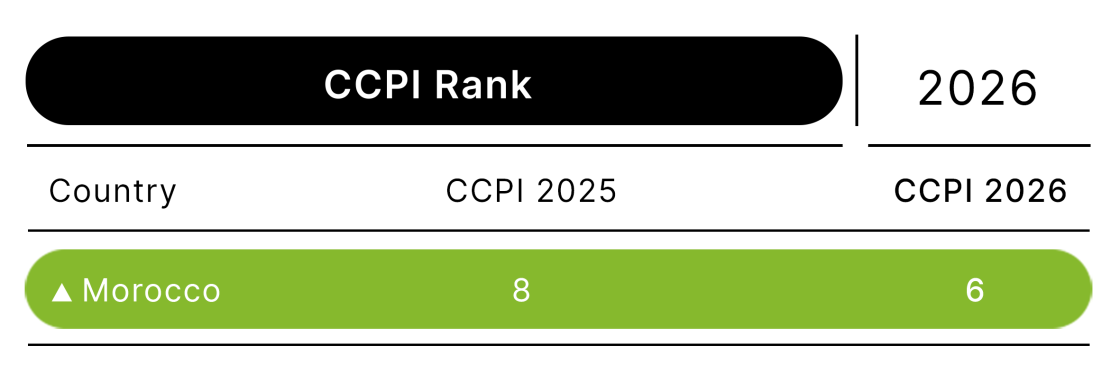
Morocco rates 6th and is among the highest performers in the CCPI. The country receives a high rating in GHG Emissions, Energy Use, and Climate Policy, and a low in Renewable Energy.
Morocco updated its Nationally Determined Contribution (NDC) in September 2025, setting a 53% reduction target for 2035 compared with a business-as-usual (BAU) scenario. The total reduction target consists of an unconditional reduction target of 21.6% reduction and a conditional target of 31.4%. The CCPI country experts welcome the government’s plan to phase out coal by 2040.
The experts mention that Morocco is not heavily involved in fossil fuel extraction, apart from untapped gas reserves. Petroleum subsidies have been in place for several years and the government struggles to remove subsidies on gas, which a great deal of the population uses. The transition planned over the next few years is currently very slow.
Low-carbon outlook is positive in transportation, though renewables need to expand more quickly
A National Adaptation Plan set minimum performance rules for new buildings. The experts criticise the lack of resources for monitoring implementation of these standards. They mention that buildings are not built to standards and, among other things, energy-intensive appliances are still sold on the market.
Major public transport and rail investments in Morocco are supporting a modal shift and long-term low-carbon mobility.
The energy sector is still seeing delays and technology disputes are slowing solar introduction. The experts call for accelerating solar and wind tenders with clear technology choices and upgrading grid flexibility. They would also like to see launching of a sustainable biofuel and biomethane roadmap focused on waste and residues rather than food crops.
The experts demand greater irrigation efficiency in Morocco by paring drip upgrades with smart solar pumping and moisture sensors, potentially tying subsidies to water-use key performance indicators. They also seek scaling of the Programme National des Déchets Municipaux (PNDM; National Municipal Solid Waste Program), such as in separating organics in big cities and expanding landfill-gas capture and power/flare wastewater methane.
Overall, the experts advise that Morocco should adopt a Paris-aligned fossil transition package, set incentives for citizen involvement, and accelerate its renewable energy expansion.
Key Outcomes
- Morocco rates 6th and is among the highest performers in the CCPI
- The country updated its NDC in September 2025
- Key demands: Morocco should adopt a Paris-aligned fossil transition package, set incentives for citizen involvement, and accelerate its renewable energy expansion
CCPI experts
The following national experts agreed to be mentioned as contributors for this year’s CCPI:
- Dr. Mohammed Saddik
- Mohammed Ajrinija (High Atlas Foundation)
- Prof. Touria Barradi