 Nigeria
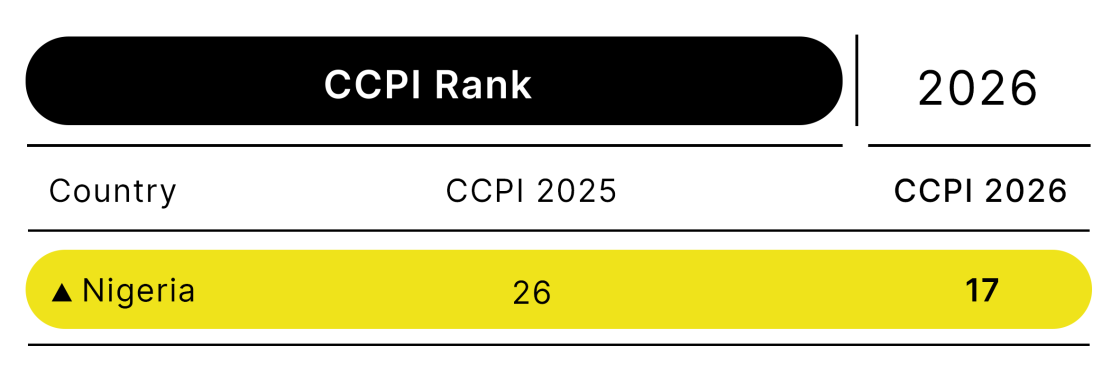
Nigeria ranks 17th in the CCPI, up nine spots. The country receives a high rating in GHG Emissions and Energy Use, very low in Renewable Energy, and low in Climate Policy.
Nigeria’s Nationally Determined Contribution (NDC) was submitted in October 2025. The CCPI country experts note that it shows a clear strategy of reducing greenhouse gas (GHG) emissions from different sectors. However, they criticise the lack of implementation thus far – something that remains especially challenging at subnational levels. Nigeria has the world’s ninth-largest gas reserves and is a major methane emitter; this accounted for 16% of sub-Saharan African methane emissions in 2010–2020. The country currently plans to increase its oil and gas production. As the federal government aims to expand domestic gas use and exports, the experts call for immediate action to prevent increasing methane emissions from the oil and gas sector. The launch of the Nigeria Energy Transition Plan (ETP) addresses residual methane and greenhouse gas (GHG) emissions, including strategies for reducing emissions at a lower cost.
Renewables struggle with human rights issues and unequal access, as myriad factors aggravate the energy crisis
With the introduction of the National Council on Climate Change in 2022, the efficiency for integrating renewable energy (RE) into the energy sector has increased through energy transition forums. Overall, Nigeria’s solar energy capacity has been steadily increasing, reaching more than 385 MV in 2024. Although the ETP supports the full expansion of RE across Nigeria, there is a major funding gap and the experts criticise the continuing lack of access to the national electricity grid for millions of citizens. The experts point out that factors such as funding problems, energy loss, inadequate budgetary provision, corruption, leadership crisis, poor maintenance, and neglect of projects cause the energy crisis.
There are also recorded human rights violations regarding RE expansion, especially concerning land grabs and inadequate compensation. The experts recommend that the government enact policies in place to protect landowners and users and to assure that RE projects pose no food security threats. The experts also point out the environmental justice issue regarding deforestation, which exposes land to degradation, loss of biodiversity, and water scarcity, and these directly and indirectly affect the livelihoods of millions of people.
Changing political leadership and implementation failures hinder non-energy sector
The experts criticise how implementation failures undermine policies in the non-energy sector. Multiple administrations have created multi-faceted plans aimed at poverty reduction, but a lack of political will, inadequate funding, and institutional inconsistences have limited their impact. Frequent government leadership changes often lead to abandonment of previous development plans, creating uncertainty among investors and hindering long-term progress.
A positive initiative of climate policy that the experts point out is the Nigeria Erosion and Watershed Management Project (NEWMAP), which operated in 2012–2022 across 23 states. This project used integrated methods and strong community involvement to address severe erosion and flood risks.
The experts urge the government to increase investment in reliable and sustainable electricity grid access for its growing population and industries, and to halt investment in carbon-intensive projects.
Key Outcomes
- Nigeria ranks 17th in the CCPI, up nine spots
- The new NDC was submitted in October 2025
- Key demands: increase investment in reliable and sustainable electricity grid access for its growing population and industries, and to halt investment in carbon-intensive projects
CCPI Experts
The following national experts agreed to be mentioned as contributors for this year’s CCPI:
- Smith Nwokocha (Quest For Growth and Development Foundation)
- Women Environmental Programme