 Romania
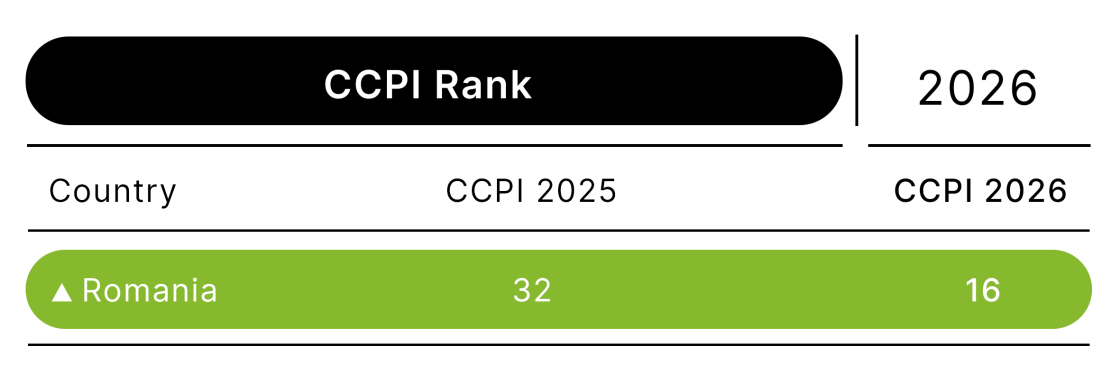
Romania ranks 16th in the CCPI, up an impressive 16 spots from last year. The country receives high ratings in GHG Emissions and Energy Use, and low in Climate Policy and Renewable Energy.
The CCPI country experts recognise several positive developments since the Long-Term Strategy (LTS) was adopted in late 2023. For instance, the potential for offshore wind generation in the Black Sea has finally been acknowledged, with major policy changes now planned to account for this potentially transformative renewable expansion. The National Recovery and Resilience Plan (NRRP) includes a coal phase-out date and obligates the government to accelerate the rollout of solar and wind nationwide. Nevertheless, the experts highlight the deficits still shaping the character of the LTS, with current targets still allowing GHG emissions of 3 MtCO2eq in 2050. This lack of ambition involves detrimental signals and weakens enforcement, the experts affirm.
Apart from an LTS upgrade, the experts call on the government to double-down on grid integration investments and electricity storage capacity building to pave the way to a more decentralised, prosumer-driven electricity grid. Consequent strengthening of governance in GHG emissions monitoring is also urgently needed to ensure compliance with national and EU regulations.
Renewables auctions progressing well, but fossil gas a ‘transition fuel’ from coal is concerning
Since the introduction of the Contract for Difference (CfD) auction scheme, two rounds of auctioning have taken place, the second completed in August 2025. The CfD-backed renewable energy capacity has now risen to 4.2 GW, well above the NRRP’s targets. A third auction is being planned with the experts expecting it to happen in the coming months. The auction will likely focus on onshore wind, fuelling the need for further electricity grid modernisation.
The government’s stance on fossil gas, including its framing as a ‘transition fuel’ needed to compensate for coal plant decommissioning, continues to concern the experts. They criticise this problem of gas replacing coal, thereby slowing decarbonisation. As a socially and ecologically sustainable alternative, the experts propose progressive energy community legislation, strengthening local communities while providing them with affordable, green energy. Not all renewable energy projects are seen as progressive, though, as some hydropower plants cut off water access and threaten ecosystem balance. The experts demand the introduction of national planning schemes to ensure minimised need for fossil gas and for renewable energy to replace coal-fired electricity generation.
Latest NECP has reasonable ambition in sectorial targets, while energy grants for vulnerable need simplifying
The most recent National Energy and Climate Plan (NECP) has relatively ambitious sectoral targets for some sectors, such as buildings, targeting a 19% emissions reduction by 2030 compared with 1990 levels. This is supposed to be achieved through a steep increase in heat pumps and solar thermal technology installation. The transport sector continues to lag, with electric vehicles (EVs) only accounting for a small share of overall car purchases. Through the REPowerEU program, the current government established a policy allocating grants and allowances to particularly vulnerable households so they can upgrade their heating systems and install solar panels. Though the experts see this scheme’s merits, they demand simpler access and eligibility criteria to expand its outreach and effectiveness.
The experts call for a renewal and expansion of Romania’s rail and subway capacity, a program for developing bicycle lanes, and the adoption of clearly defined energy efficiency norms for building renovation. The experts also demand that all new gas exploration projects in the Black Sea end and that there is stronger enforcement of existing laws to halt illegal logging, thereby protecting natural carbon sinks. They also want to see reinforced oversight from state authorities, something that has thus far remained limited, preventing progress in GHG emissions reduction in non-energy sectors.
Key Outcomes
- Romania ranks 16th in the CCPI, up an impressive 16 spots from last year
- The CCPI country experts recognise several positive developments since the Long-Term Strategy was adopted in late 2023
- Key demands: renewal and expansion of Romania’s rail and subway capacity, a program for developing bicycle lanes, and the adoption of clearly defined energy efficiency norms for building renovation
CCPI experts
The following national experts agreed to be mentioned as contributors for this year’s CCPI:
- Laura Nazare (Bankwatch Romania)